

Inside Juuri's ESG report 2025
From commitment to action: how and where we're making a real difference

"The global political landscape has fundamentally reshaped how companies think about ESG - moving the conversation from aspirational pledges to a more fraught and operationally serious arena. Geopolitical instability has forced companies to treat ESG more as a risk management tool. Although sustainability is changing the value creation opportunities remain. Even during the last turbulent years we have had our focus on strategic, value creative ESG projects with our portfolio companies."
Tapani Varjas
Partner
Juuri Partners
At Juuri Partners, ESG isn't a category or a filter. It's a way to understand how companies grow and what that growth impacts. We invest in sectors where sustainability and governance are often difficult to define—manufacturing, logistics, materials—but essential to get right. We look at ESG as a practical lens on long-term performance and resilience.

Key figures
Where we stand today
100%
of team members trained in ESG during last year.
6x
workshops with portfolio companies last year
>90%
of portfolio companies reporting ESG data
Download the full report


"This year we shifted our focus from gathering information to building capability. We ran emissions calculation training across the portfolio, conducted double materiality assessments with newer companies, and workshopped practical improvements with each team. The goal was never to produce a perfect spreadsheet but to make sure the people running these companies understand their own numbers well enough to act on them. There is a lot of noise in the market right now about what ESG should or should not be, but for us the answer has always been straightforward: companies that understand their operations, treat their people well, and manage their risks properly are better positioned for long-term success, and that's what we are here to build."
Maiju Saarela
Sustainability Manager
Juuri Partners
This year, we made key advancements in our emissions analysis. By expanding our calculations to include services at the holding company level, we've refined our data processes and gained greater transparency into our environmental impact.
This clarity helps us identify key emission hotspots and prioritise targeted reductions. At the same time, our team has strengthened its expertise in Greenhouse Gas (GHG) inventory practices, positioning us to better support portfolio companies in developing accurate emissions baselines and transitioning to activity-based metrics.


"Better working life, proper risk management and sustainability-driven business development are everyday realities in Juuri Funds’ portfolio companies. Sustainability stays on the agenda with entrepreneurs and management, always targeting genuine ownership value, always executed pragmatically, and always communicated clearly. Trends come and go, but Juuri's sustainability strategy has been built to last. Long-term commitment creates real competitive advantage. We report improving results, but what matters more is strengthening company cultures."
Samuli Sipilä
Managing Director
Juuri Partners
Our efforts
Sustainability has been at core of Juuri since day one.
A year in practice: three portfolio stories
Juuri Partners
How we helped our portfolio companies take the first steps in carbon accounting
One of the challenges we see regularly across our portfolio companies is that emissions measurement can feel abstract and inaccessible, particularly for smaller businesses without dedicated sustainability teams. Rather than waiting for each company to figure it out on its own, we decided to bring everyone together and work through it collectively.
In 2025, Juuri Partners organised an emissions calculation training for all portfolio companies. The training focused on Scope 1 and Scope 2 emissions, walking participants through the fundamentals of greenhouse gas accounting, from understanding emission boundaries to working with the data sources they already had available. The goal was not to turn every company into a carbon accounting specialist, but to give them a practical starting point and the confidence to begin measuring their own direct and energy-related emissions.
This kind of capability building is central to how we work. We believe that portfolio companies are more likely to act on sustainability when they understand the tools and methods behind it, rather than simply being handed a set of numbers or a reporting template. By running the training as a shared session, we also created space for companies to learn from each other's questions and experiences.
The training is one example of our broader approach to sustainability support: pragmatic, hands-on, and designed to build lasting capability rather than dependence on external consultants.

Nitor
Building sustainable digital success
Every digital service touches real people. It handles their data, shapes their choices, and either includes them or leaves them out. This is where sustainability becomes concrete for Nitor as it works with its customers to create inclusive, secure, and trustworthy solutions.
Nitor has invested in sustainability for several years and published its second sustainability report in 2026. The process has been as valuable as the result: it has sharpened Nitor's understanding of where the real sustainability risks and opportunities lie and made the work visible both inside the company and to the outside world. Alongside the report, we have created a sustainability narrative that defines how we communicate about sustainability, particularly to our employees. To make decisions based on long-term values, clarity matters.
As AI becomes part of almost every digital product, the questions surrounding it have grown more consequential. Whose data is used, and how? Where must human judgment remain in the loop? Nitor takes a clear stance: responsible AI use is a deliberate choice, made both in how AI is adopted internally and in how it is applied in customer projects. In 2025, Nitor delivered compulsory AI literacy training across the organisation to ensure that stance is consistently applied in practice. A new AI Culture team was also established, bringing together cross-functional participants to make responsible AI adoption a shared responsibility across the organisation.
Information security is a core part of building trustworthy solutions. To maintain security standards, Nitor carried out an internal audit of its Information Security Management System in accordance with ISO/IEC 27001:2022. The purpose was to evaluate the effectiveness of controls and identify areas for improvement, laying the groundwork for certification in the first half of 2026.
Accessibility is the third pillar of this thinking. Nitor has built strong in-house expertise in the field, with 62 W3C-certified specialists and five experts holding the more advanced IAAP certification. In practice, this means helping customers embed accessibility into their development work from the start rather than treating it as a compliance exercise. Nitor's collaboration with Elisa is a good example of this: together, they built lasting accessibility competence across Elisa's development teams, making it a genuine part of how they work every day.
For a digital consultancy, the greatest sustainability impact comes through customer work. Nitor aims to be a partner that helps customers make better choices for the people who use their digital services.
Kiho
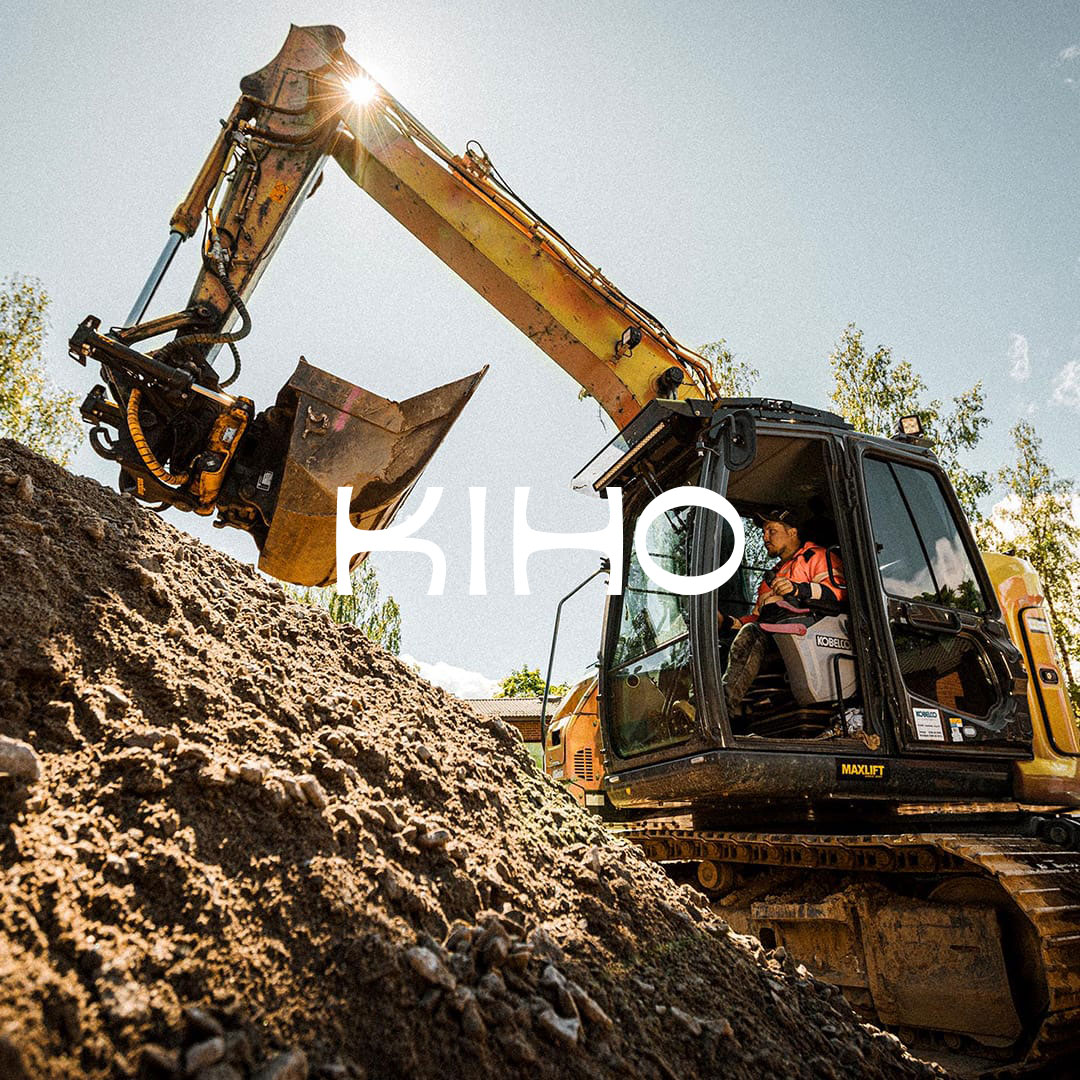
How a simple travel policy reshaped Kiho's mobility footprint
At Kiho, business travel has traditionally been carried out using both company cars and employees' personal vehicles, with mileage reimbursements (kilometrikorvaus) claimed afterwards. Over time, this covered everything from client meetings to internal meetings and routine site checks, and as the total kilometres grew, so did the associated carbon footprint.
In mid-2025, the company took a closer look at how these trips were actually being made and introduced a revised travel policy. Going forward, car travel would be reserved for client meetings only. For everything else, employees were encouraged to use public transport or connect remotely via video call. It was not a dramatic overhaul, but a conscious choice to question a long-standing habit.
The effect was swift. In H1 2025, total business travel by car amounted to approximately 97,400 km. By the second half of the year, that figure had fallen to 66,000 km, a 32% drop in just six months. Compared to H2 2024, when the equivalent figure exceeded 116,000 km, the reduction stands at 43%. What made the difference was not new technology or infrastructure, but a clear policy backed by consistent follow-through from management.
With fewer kilometres on the road, the emissions impact follows directly. Kiho continues to track its travel data and is looking at what further changes can be made to keep the trajectory heading in the right direction.
Read full cases in report
PRI assessment report results 2025
We are continuously improving our sustainability practices. Our latest PRI report demonstrates strong ESG advancements, with notable improvements in Direct - Private Equity
Policy governance and strategy
★★★★★
69
75
76
Direct - Private equity
★★★★★
85
89
98
Confidence building measures
★★★★★
60
100
100
PRI Median
2023
2024
2025
Module score
★★★★★
(0<=25%)
★★★★★
(>25%<=40%)
★★★★★
(>40%<=65%)
★★★★★
(>65%<=90%)
★★★★★
(>90%)
Policy governance and strategy
★★★★★
69
75
76
Direct - Private equity
★★★★★
85
89
98
Confidence building measures
★★★★★
60
100
100
PRI Median
2023
2024
2025
Contact us
Interested in hearing more?
Maiju Saarela
Sustainability Manager
Juuri Partners
+358 40 515 4297
maiju.saarela@juuripartners.fiAddress
Keskuskatu 5 B, 5th floor
00100 Helsinki